
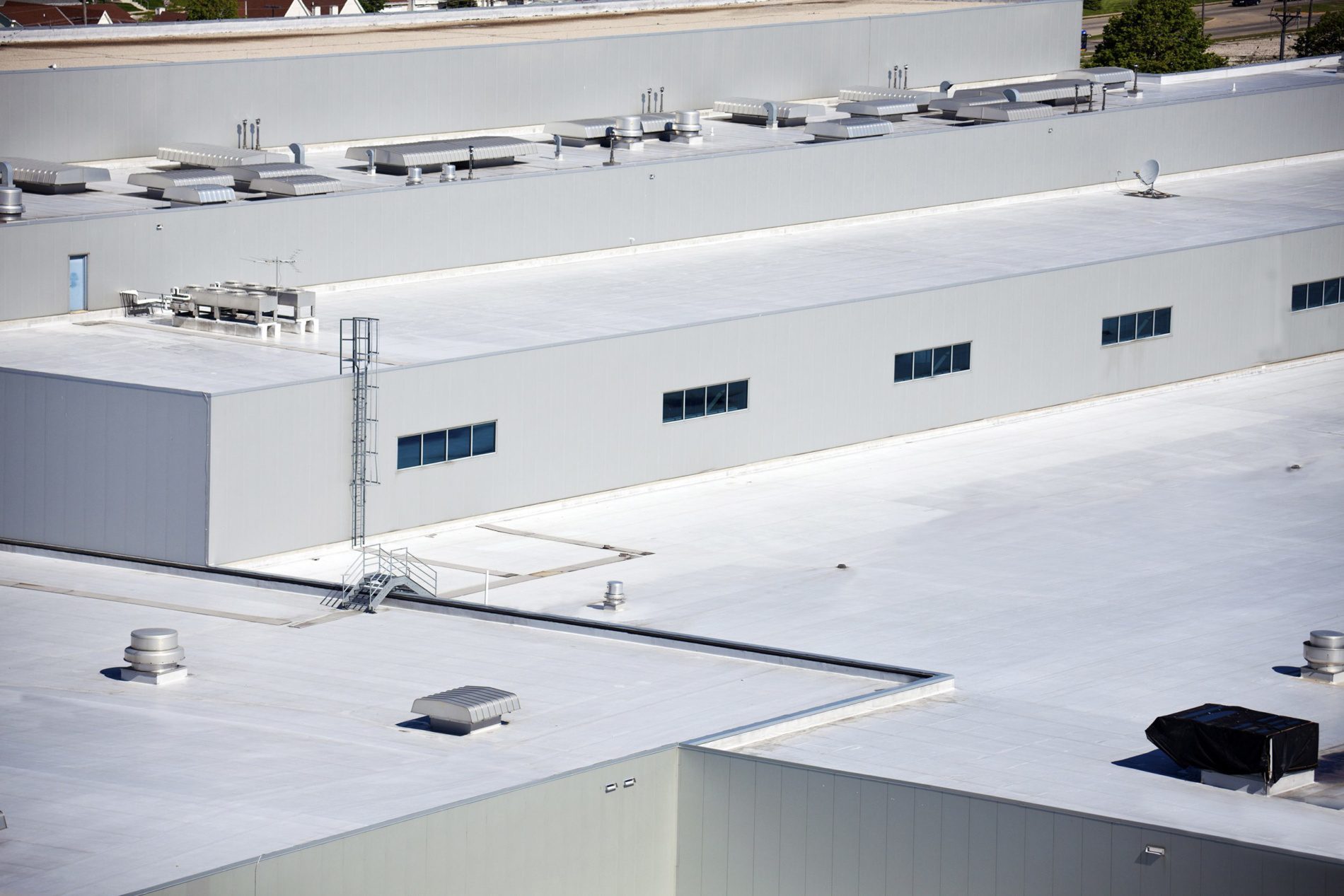
Bakersfield's economy is defined by oil and gas production and agricultural processing, and Chevron's extensive operations throughout Kern County represent the kind of industrial environment where commercial roofing intersects with hazardous material handling, process safety, and operational complexity that standard contractors are not equipped to manage. Manufacturing and processing facilities across the Bakersfield area — from oil field equipment manufacturers to large-scale food processing plants — face roofing conditions shaped by San Joaquin Valley heat, persistent particulate air quality challenges, and the operational demands of industries that run continuously.
Process equipment on Bakersfield manufacturing and processing roofs includes cooling towers for refinery temperature control, industrial exhaust and gas management systems for oil and gas operations, and heavy process ventilation for food processing facilities. Many of these systems are safety-critical in the oil and gas context — interrupting them is not an option under any circumstances. We document all roof-mounted equipment before mobilizing, identify operational constraints and safety requirements, and design work sequences that never approach equipment that cannot be taken offline. Our field supervisors hold OSHA 30 certifications and understand the safety culture requirements of oil and gas processing environments.
Chemical and fume exposure at Bakersfield oil and gas and food processing facilities represents some of the most aggressive membrane degradation environments in California. Hydrocarbon vapors from oil field equipment manufacturing and refinery operations attack petroleum-based roofing compounds and can degrade even synthetic membranes over time. Food processing generates organic acid vapors, steam, and cleaning chemical mists that create biological and chemical attack on membrane surfaces simultaneously. We assess the specific chemical environment at each facility and specify membrane systems accordingly — hydrocarbon-resistant formulations for oil-adjacent operations, and materials appropriate for each food processing environment.
San Joaquin Valley heat is severe and prolonged. Bakersfield regularly records summer temperatures above 110 degrees Fahrenheit, and roof surface temperatures in July and August can exceed 180 degrees Fahrenheit. This extreme heat affects installation quality, membrane performance, and worker safety simultaneously. We adjust installation protocols for Bakersfield summer conditions, specify membranes with thermal stability ratings appropriate for extreme San Joaquin Valley temperatures, and enforce heat stress management protocols that are significantly more stringent than standard OSHA requirements. Afternoon roof work in July in Bakersfield requires genuine heat illness prevention planning.
San Joaquin Valley air quality — consistently among the worst in California — creates a specific particulate challenge for Bakersfield manufacturing roofs. Agricultural dust, oil field dust, and general atmospheric particulate accumulate on roof surfaces and in drain fields at rates that accelerate membrane surface degradation and drain blockage. The same air quality conditions that affect residents affect roofing membranes: UV radiation combined with particulate contamination on the membrane surface creates an abrasive oxidizing environment that reduces service life. We specify reflective coatings with UV stabilizers for Bakersfield applications and include drain maintenance in our service programs.
Vibration from Bakersfield manufacturing operations — oil field equipment manufacturing, agricultural equipment production, and food processing lines — transmits into roof decks and stresses membrane systems over time. Heavy stamping and fabrication equipment generates cyclic loads that loosen mechanically fastened insulation and fatigue seams at rigid transitions. We assess vibration environment before specifying fastener type and density, and we use fully adhered systems in high-vibration areas where mechanical fastening would create pull-through failure patterns. At food processing facilities where high-pressure wash-down is standard, we also address the moisture management implications of daily sanitation cycles.
Large skylights at Bakersfield food processing and manufacturing facilities are exposed to some of California's most intense UV radiation and highest temperatures. Original polycarbonate and acrylic glazing units installed more than 15 years ago have typically lost their UV stabilizer effectiveness and show significant yellowing, brittleness, and frame seal failure. Replacement with units designed for extreme desert conditions — UV-stable glazing, aluminum framing with appropriate thermal break design, and sealing systems that accommodate the dimensional changes driven by 180-degree roof surface temperatures — is the correct long-term solution. We coordinate replacement scheduling with facility operations to prevent production disruption.
Drain design at Bakersfield manufacturing facilities must account for two opposing challenges: the Valley's intense but rare rain events can overwhelm undersized drain systems, and the months between significant rainfalls allow dust and process particulate to accumulate to blockage levels. We size drain systems for design storm events per California Building Code, add overflow scuppers at all roof perimeters, and specify strainer systems that can be field-cleared quickly after dust accumulation periods. Post-storm inspections are part of our service program for Bakersfield manufacturing clients, ensuring that drain systems are clear before the next weather event.
California energy code requirements add specification obligations to Bakersfield manufacturing roofs that affect material selection and system design. Title 24 cool roof requirements mandate minimum solar reflectance and thermal emittance values, which in Bakersfield's extreme heat environment also benefit facility energy costs significantly. We specify compliant membranes, document performance ratings for Title 24 submittals, and in many cases achieve cool roof performance that reduces cooling load measurably. Air district regulations affecting VOC content in adhesives and sealants must also be managed — we maintain current knowledge of San Joaquin Valley APCD requirements and use compliant products.
- Do you hold certifications required for oil and gas processing facility work in Kern County?
- Our field supervisors hold OSHA 30 certifications, and we complete site-specific safety orientation for every oil and gas facility before mobilizing. We maintain familiarity with the Chevron, TexacoKerr McGee, and other major operator safety management systems active in Kern County.
- How do you handle membrane installation during Bakersfield's extreme summer heat?
- We schedule heat-sensitive operations for morning hours, adjust adhesive application rates and set times for high-temperature conditions, and enforce heat illness prevention protocols with mandatory rest and hydration breaks. We do not waive these protocols to meet schedule pressure.
- What membrane types resist hydrocarbon vapor exposure in oil and gas environments?
- We typically specify KEE formulations or select TPO compounds with documented hydrocarbon resistance for oil-adjacent applications. The specific specification depends on the concentration and compound mix at each facility, and we obtain that data before finalizing material selection.
- How often do roof drains need service in Bakersfield's dusty environment?
- At minimum twice annually — after the wet season and mid-summer when dust accumulation has been building through the dry months. We recommend quarterly inspections for facilities near agricultural operations or oil field activity, where particulate load is highest.
- Are Title 24 cool roof requirements mandatory for manufacturing facilities?
- Yes. California Title 24 applies to commercial and industrial buildings including manufacturing facilities. Cool roof requirements specify minimum solar reflectance and thermal emittance for low-slope applications. We document compliance in all permit submittals for Bakersfield projects.